
2026 Monthy Calls

January Call Breakdown
During the month of January, Lookingglass Rural Fire District responded to a total of 15 calls for service within the district. These calls included a wide range of incidents requiring volunteer response and coordination:
- 7 Medical Aids
- 1 Medical Standby
- 1 Motor Vehicle Accident (MVA)
- 2 Fire Alarms
- 2 Illegal Burns
- 1 Water Rescue
- 1 Good Intent Call
January Fire Safety Information
January is historically a higher-risk month for residential fires due to colder weather and increased use of heating sources. LRFD encourages all residents to take the following precautions to reduce fire risk:
- Maintain a minimum three-foot clearance between space heaters and combustible materials.
- Never leave fireplaces, wood stoves, or portable heaters unattended.
- Ensure chimneys and stove pipes are inspected and cleaned as needed.
- Test smoke alarms and carbon monoxide detectors regularly and replace batteries as necessary.
- Follow all local and state burn regulations and avoid illegal burning.
Thank you for your continued support of LRFD and for helping keep our community safe throughout the winter season.

February 2026 Call Summary
In February 2026, Lookingglass Rural Fire District (LRFD) was dispatched to 12 calls for service. Responses included fire-related incidents, investigations, and support to EMS partners for medical calls within the district.
Call Breakdown (12 Total)
- 7 Medical Aids
- 1 Illegal Burn
- 1 Fire Alarm
- 1 Smoke Investigation
- 1 Motor Vehicle Accident (MVA)
- 1 Good Intent Call
Medical Calls in the LRFD District
All medical aids in the LRFD district are covered by the ambulance service assigned to our area. The two ambulance providers serving Lookingglass are Central Douglas Fire & Rescue and Umpqua Valley Ambulance.
On all medical aids, the ambulance is the primary agency, and LRFD responds to assist and support ambulance operations as needed. This assistance may include scene support, access and movement help, traffic control, and overall scene safety.
Mutual Aid and Staffing
- Mutual Aid Given: 1
- Unable to Respond (no certified responders available): 1
Thank you to our volunteers and partner agencies for their continued service and support.
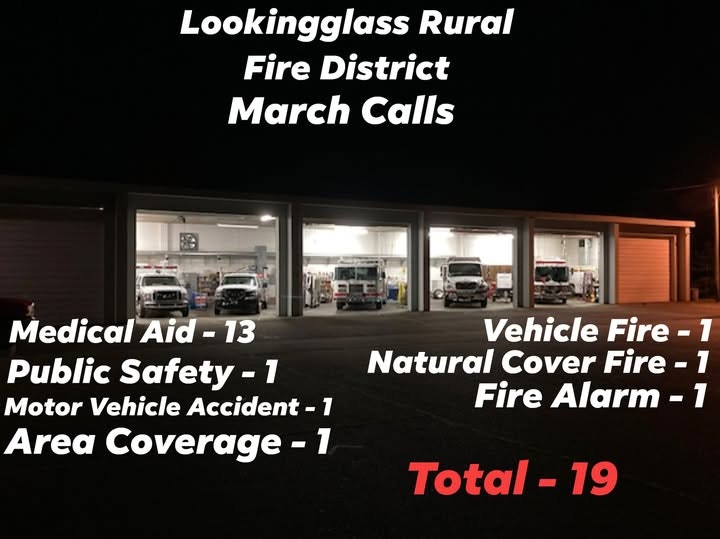
March 2026 Monthly Activity Summary
Lookingglass Rural Fire District responded to 19 calls for service during the month of March. As a first responder agency, LRFD continues to provide initial emergency care and scene support alongside Umpqua Valley Ambulance and Central Douglas Fire & Rescue on medical incidents. The district also remained engaged in mutual aid operations, receiving assistance once and providing assistance once to neighboring agencies.
Call Breakdown for March
- Medical Aids (13): Response to medical emergencies providing patient assessment, treatment, and support until ambulance transport arrives.
- Vehicle Fire (1): Suppression of a vehicle fire, including hazard control and scene safety.
- Public Safety Assist (1): Assistance with non-fire emergencies such as hazard removal or support to other agencies.
- Natural Cover Fire (1): Response to a vegetation fire involving grass, brush, or light fuels.
- Fire Alarm (1): Investigation of an activated fire alarm system to determine cause and ensure safety.
- Motor Vehicle Accident (MVA) (1): Response to a traffic collision involving scene control, patient care, and hazard mitigation.
- Area Coverage (1): Staffing or covering another jurisdiction’s area to maintain emergency response readiness.
Training and Professional Development
March was a highly active training month for LRFD personnel. Several firefighter trainees are currently enrolled in a NFPA Firefighter 1 Academy, committing approximately 160–180 hours of classroom and hands-on instruction to meet certification requirements.
Members also attended Emergency Medical Responder (EMR) training through Tenmile Rural Fire District, totaling approximately 80–100 hours focused on emergency medical care and patient management.
LRFD had five volunteers participating in the Umpqua Community College Fire Science program, all of whom successfully completed their Task Performance Evaluations (TPEs) this month, demonstrating competency in Firefighter 1 skills.
In addition, LRFD had two students enrolled in EMT-Basic through UCC. One student successfully completed the program and passed the National Registry of Emergency Medical Technicians (NREMT) examination. EMT training typically involves 150–200+ hours of coursework, clinical experience, and skills evaluation.
Personnel also attended vehicle fire training hosted by North Douglas Fire & EMS, with instruction delivered in alignment with **Oregon Department of Public Safety Standards and Training standards.
Weekly Training and Operations
LRFD continued its regular Thursday night drills, focusing on hands-on training and operational readiness. Throughout the month, members trained in preparation for the upcoming April 25th Burn to Watch event, utilizing an acquired structure to study fire behavior, smoke conditions, and water application effects.
The district also conducted its annual agility testing, which is required for personnel participating in interior fire operations. The agility course evaluates functional fireground capabilities, including:
- Donning full PPE and SCBA
- Hose deployment and advancement
- Equipment carries
- Ladder operations
- Simulated victim rescue
This testing ensures firefighters are physically capable and operationally prepared to meet the demands of interior structural firefighting.
LRFD remains committed to maintaining a high level of readiness through consistent training, strong mutual aid partnerships, and dedicated volunteer service to the community.

April was an active and highly productive month for Lookingglass Rural Fire District, with a strong focus on emergency response, training, and professional development.
Emergency Response Activity
LRFD responded to a total of 21 calls for service during the month of April:
- Medical Aid: 10
- Lift Assists: 3
- Structure Fires: 3
- Motor Vehicle Accident: 1
- Natural Cover Fire: 1
- Illegal Burn: 1
- Good Intent Call: 1
- Public Safety Assist: 1
In addition to in-district responses, LRFD personnel provided mutual aid assistance on 4 occasions, supporting our regional partners and reinforcing cooperative emergency response across Douglas County.
Training and Community Involvement
Training and education remained a priority throughout April:
LRFD instructors, working alongside personnel from Tenmile Rural Fire District, Glide Rural Fire Protection District, and North Douglas County Fire & EMS, spent eight school days instructing students in the Douglas High School Fire Science program offered through Umpqua Community College. This partnership continues to build a strong foundation for future emergency service professionals.
LRFD also hosted a Basic Fire Cause and Origin Investigation course, providing firefighters with essential knowledge and hands-on experience in determining fire origin and cause—an important responsibility for fire agencies.
Additionally, LRFD conducted a “Burn to Learn” training at a donated structure in the Flournoy Valley area. This training provided valuable, controlled live-fire conditions that allowed personnel to observe fire behavior and apply suppression techniques in a realistic environment.
Member Training and Readiness
Throughout the month, LRFD volunteers remained committed to improving readiness and operational capability. Members participated in:
- Emergency Medical Responder (EMR) training through Tenmile Rural Fire District
- Emergency Medical Technician (EMT-Basic) training through Umpqua Community College
- Ongoing preparation of personal properties and defensible space ahead of the upcoming fire season
Certifications and Achievements
LRFD is proud to recognize the accomplishments of our personnel during April:
- 3 members achieved NFPA Firefighter I certification
- 2 members achieved NFPA Driver Operator certification
- 3 members completed HazMat Awareness and Operations certification
- 1 member obtained National Registry EMT-Basic certification
Moving Forward
Lookingglass Rural Fire District continues to prioritize training, interagency cooperation, and community preparedness. The dedication shown by our volunteers ensures that we remain ready to meet the needs of the Lookingglass community and support our mutual aid partners.
We appreciate the continued support from our community and look forward to continued growth and service in the months ahead.

May 2026 Call Statistics
During the month of May, Lookingglass Rural Fire District responded to 26 calls for service throughout our district and surrounding mutual aid areas.
Call Breakdown
- 17 Medical Aids
- 2 Controlled Burns
- 1 Natural Cover Fire
- 1 Illegal Burn
- 1 Motor Vehicle Accident
- 1 Commercial Fire
- 2 Good Intent Calls
- 1 Public Safety Call
In addition to emergency responses within our district, LRFD personnel:
- Provided mutual aid assistance 3 times to neighboring agencies.
- Received mutual aid assistance 1 time from our partner agencies.
What These Calls Mean
Medical Aid
Responses involving medical emergencies including illness, injury, cardiac events, breathing difficulties, falls, and other situations requiring emergency medical care.
Controlled Burn
A planned and authorized burn conducted under specific conditions for vegetation management, agricultural purposes, or hazard reduction.
Natural Cover Fire
Any fire involving grass, brush, timber, vegetation, or other natural fuels.
Illegal Burn
A burn conducted outside of legal requirements, permit conditions, or fire season restrictions.
Motor Vehicle Accident (MVA)
Responses involving vehicle crashes where firefighters may provide traffic control, patient care, vehicle stabilization, fire suppression, or extrication support.
Commercial Fire
A fire occurring within a commercial occupancy such as a business, industrial facility, office, or commercial structure.
Good Intent Call
An incident where emergency resources are dispatched but no emergency exists upon arrival. Examples include canceled alarms, controlled situations, or smoke mistaken for fire.
Public Safety Call
Responses involving public hazards, welfare concerns, community assistance, or other situations impacting public safety.
Training and Community Activities
While responding to emergency incidents, LRFD volunteers remained actively engaged in training and community service throughout May.
Weekly Training
Our volunteers continued attending weekly Thursday night drills from 7:00 PM to 9:00 PM, with a special emphasis on:
- Wildland firefighting operations
- Fire shelter deployment
- Progressive hose lays
- Water supply operations
- Structure protection tactics
- Fire season preparedness
Additional Training and Events
Throughout May, LRFD personnel also:
- Attended a Burn to Learn live fire training hosted by our mutual aid partners at Tenmile Rural Fire District
- Participated in a 3-Day NFPA Rope Rescue Operations Course
- Hosted and attended a Traffic Incident Management (TIM) Course
- Assisted with the annual Lookingglass Cemetery Clean-Up Day
These opportunities help ensure our volunteers remain prepared to safely and effectively serve our community.
Fire Season Has Begun
Fire season officially began on May 31, 2026.
As temperatures rise and fuels continue to dry, we encourage everyone to take extra precautions to prevent wildfires.
Fire Season Safety Tips
- Keep grass and vegetation mowed around structures.
- Maintain at least 100 feet of defensible space around your home.
- Never park vehicles on dry grass.
- Ensure trailer chains do not drag on roadways.
- Keep spark arrestors in place and functioning.
- Have water and fire extinguishers available during outdoor work.
- Avoid activities that generate sparks during hot, dry, and windy conditions.
- Know multiple evacuation routes from your property.
- Sign up for local emergency notifications.
Agricultural Operations Reminder
While fire season restrictions are now in effect, agricultural operations remain exempt from many seasonal restrictions when conducted in accordance with applicable regulations and safe operating practices. Agricultural producers should still exercise extreme caution and maintain firefighting equipment when operating during periods of elevated fire danger.
Join Us for the LRFD Open House
Saturday, June 27, 2026
12:00 PM – 5:00 PM
We invite everyone to visit Lookingglass Rural Fire District for an afternoon of community, education, food, and fun.
Food and Refreshments
We would like to thank:
- Workmans Bar and Smokehouse
- Workmans Construction
for generously donating food and preparation services for the event.
Visitors can also enjoy refreshments from the Lookingglass Brewery beer trailer. Lookingglass Brewery has graciously committed to donating 25% of all beer sales during the event to LRFD.
Supporting Firefighter Safety
Funds raised during the Open House will support LRFD's goal of purchasing:
- A turnout gear extractor specifically designed to safely clean structural firefighting gear.
- A turnout and hose drying cabinet designed to properly dry gear and hose after cleaning.
These items are important firefighter health and safety equipment that help reduce exposure to carcinogens while extending the service life of our protective equipment.
Parking and Shuttle Service
Parking will be available at:
- Lookingglass Elementary School
- Lookingglass Grange
LRFD volunteers will provide shuttle transportation to and from the station utilizing our Rescue Unit and Brush Truck.
Thank You to Our Partners
We would also like to extend our sincere appreciation to the agencies that plan to participate in our Open House, staffing and emergency response permitting:
- Douglas Forest Protective Association
- Tenmile Rural Fire District
- Camas Valley Rural Fire Protection District
- Umpqua Valley Ambulance
- Central Douglas Fire & Rescue
- Douglas County Emergency Management
- REACH Air Medical Services
- Oregon State Fire Marshal
The partnerships we maintain throughout Douglas County are critical to ensuring the highest level of service to our community. We look forward to seeing everyone on June 27th as we celebrate our volunteers, our partners, and the community we are proud to serve.

Lookingglass Rural Fire District had a busy and productive June as our volunteers responded to emergencies, continued training for fire season, and welcomed the community into the station for our 62nd Anniversary Open House.
June Calls for Service
In June, LRFD responded to 23 calls for service:
- 10 Medical Aid Calls
- 5 Natural Cover Fires
- 2 Good Intent Calls
- 2 Lift Assists
- 2 Illegal Burn Responses
- 1 Motor Vehicle Accident
- 1 Public Safety Call
LRFD also provided mutual aid to partner agencies 4 times and received mutual aid assistance 2 times.
Training
Throughout the month, LRFD members continued hands-on training in areas including Rope Rescue Operations and Wildland Firefighting. These trainings help prepare our volunteers for the wide variety of emergencies they may face while serving the Lookingglass community.
62nd Anniversary Open House
LRFD was proud to host our 62nd Anniversary Open House in June. This event gave community members the opportunity to visit the station, meet our volunteers, see our apparatus and equipment, and view the work completed following the station’s recent seismic retrofit.
Thank you to everyone who came out to celebrate with us. Your continued support means a great deal to our district.
Fire Season Reminder
Fire season is currently in effect. LRFD appreciates our community for staying safe, being aware, and helping reduce wildfire risk.
Please continue to follow current fire restrictions, use caution outdoors, and report smoke or fire immediately by calling 911.
Thank you for supporting Lookingglass Rural Fire District and the volunteers who serve our community.

July 2026 Monthly Recap
July was one of the busiest and most demanding months of the year for the volunteers of Lookingglass Rural Fire District. While continuing to answer emergency calls throughout our district, LRFD personnel also deployed to major wildfires across Oregon, demonstrating our commitment to protecting both our local community and communities throughout the state.
During the month of July, LRFD responded to 29 calls for service, including:
- 12 Medical Aid calls
- 5 Natural Cover Fires
- 4 Smoke Investigations
- 1 Commercial Fire
- 1 Structure Fire
- 1 Vehicle Fire
- 1 Motor Vehicle Accident
- 1 Lift Assist
- 1 Public Assist
- 1 Good Intent Call
- 1 State Conflagration Deployment
Mutual aid continues to be an important part of emergency response in Douglas County. During July, LRFD provided mutual aid to neighboring agencies on seven incidents while receiving mutual aid assistance on three incidents.
All 12 medical aid responses were provided as first responder assistance to Umpqua Valley Ambulance and Central Douglas Fire & Rescue, the primary Ambulance Service Area (ASA) providers for our district. Our volunteers respond to begin patient care and provide lifesaving interventions until transporting ambulance crews arrive on scene.
In addition to emergency response, members spent the month sharpening critical skills through training focused on pump operations, apparatus driver training, and wildland firefighting. These training opportunities ensure our volunteers remain prepared for the wide variety of emergencies we respond to throughout the year.
July also saw LRFD personnel deployed to two significant wildfire incidents in Oregon.
On July 11, one LRFD firefighter deployed as a Line EMT-Basic to the Evans Creek Fire, providing medical care to firefighters working on the incident. The deployment concluded on July 25 after nearly two weeks of service.
Then, on July 23, LRFD's new Oregon State Fire Marshal (OSFM) Tactical Tender and a two-person crew deployed as part of the Douglas County Structural Protection Task Force to the Brewer Fire. As fire activity increased, the Brewer Fire merged with two additional fires, becoming the Rowe Creek Complex. The Douglas County Task Force was assigned to the Rowe Creek West Division, where crews provided structure protection, water supply operations, and wildfire suppression until returning home on August 3.
Deployments through the Oregon State Fire Marshal Conflagration Act provide benefits that extend well beyond assisting communities affected by wildfire. While protecting lives and property remains the primary mission, these deployments also help strengthen rural fire districts like LRFD.
When the district deploys an apparatus through the Conflagration system, LRFD receives reimbursement for the apparatus while it is assigned outside of our district. Firefighters also receive compensation for their time while serving away from their families and regular employment. Rather than relying solely on local tax revenue, these reimbursements provide an additional funding source that allows the district to continue investing in firefighter safety, training, and equipment.
Revenue generated through deployments has helped support purchases such as updated training equipment, personal protective equipment (PPE), and other mission-critical resources that improve our ability to serve the Lookingglass community. Just as valuable is the experience our volunteers gain while working alongside firefighters from across Oregon on large, complex incidents. They return home with expanded knowledge, enhanced skills, and practical experience that directly benefits our residents.
The volunteers of Lookingglass Rural Fire District are proud to serve both our local community and the State of Oregon. Whether responding to emergencies at home, assisting neighboring agencies through mutual aid, or deploying to protect communities threatened by wildfire, our members remain committed to providing professional, dependable service whenever and wherever they are needed.
Thank you to our volunteers, their families, and the residents of the Lookingglass community for your continued support.

August 2026 Monthly Recap: 40 Calls for Service
August was another busy month for the volunteers of Lookingglass Rural Fire District (LRFD). Throughout the month, our personnel responded to emergencies, trained to maintain and improve their skills, supported neighboring agencies, provided medical coverage at a community event, and participated in activities here in Lookingglass.
August Calls for Service
LRFD received 40 calls for service during August 2026, including:
- 14 Medical Aids
- 6 Natural Cover Fires
- 5 Lift Assists
- 4 Public Safety Calls
- 3 Medical Standbys
- 2 False Alarms
- 2 Illegal Burns
- 1 Structure Fire
- 1 Motor Vehicle Accident
- 1 Smoke Investigation
- 1 Vehicle Fire
Total Calls for Service: 40
During the month, LRFD also provided mutual aid 8 times and received mutual aid 2 times.
Understanding LRFD's Medical Response
Our medical response system works a little differently from traditional fire-service mutual aid.
Medical emergencies within our response area fall under the Ambulance Service Area (ASA) assigned to that location. LRFD responds as a first-response agency, providing initial patient assessment, treatment, stabilization, manpower, and assistance to the responding ambulance crew.
Medical calls involving Umpqua Valley Ambulance (UVA) are not counted as fire-service mutual aid. When Central Douglas Fire & Rescue (CDF&R) responds with an ambulance, the incident may be classified as aid provided or received depending on the jurisdiction and circumstances of the call.
Because of this, our reported mutual-aid numbers represent fire-service mutual aid and do not reflect every incident where LRFD personnel work alongside another emergency-service agency.
Volunteer Staffing and Emergency Response
LRFD remains primarily a volunteer fire district and does not maintain year-round, around-the-clock station staffing. When an emergency is dispatched, our volunteers respond from their homes, workplaces, schools, and wherever else they may be when the call comes in.
During fire season, the Oregon State Fire Marshal Wildfire Staffing Grant allows LRFD to staff our station with two personnel from 11:00 a.m. to 7:00 p.m., seven days a week. This seasonal funding provides an important improvement in daytime response capabilities during the period when wildfire activity is at its highest.
Recruit Hippo participants completed their required hours early in August, which resulted in fewer personnel regularly being present at the station during the remainder of the month.
Unfortunately, LRFD was unable to respond to one call for service during August. That incident was handled directly by the ambulance provider responsible for the area.
While we strive to answer every call, this demonstrates one of the realities faced by a rural volunteer fire district without 24-hour station staffing. Our ability to respond depends on trained volunteers being available when the pager sounds.
Training for the Next Call
Training never stops for our volunteers. During August, personnel continued working on both seasonal readiness and the fundamental skills needed to respond safely and effectively to emergencies.
Training included:
- Wildland firefighting
- Pump operations
- Rope rescue
- Basic firefighting skills
- Medical response skills
Hands-on training is especially important for a volunteer department like LRFD. Our personnel must be prepared to respond to everything from medical emergencies and vehicle crashes to structure fires, wildland fires, rescues, and public safety incidents.
Many of our volunteers are also currently enrolled in Umpqua Community College Fire Science programs and will return to classes on September 15. Our cadets also return to school September 1.
These members balance school, employment, family responsibilities, fire department training, and emergency calls while continuing their education and development within the fire service. We are proud of the commitment they make to both their education and their community.
Oregon High School Rodeo Medical Standby
From August 28–30, LRFD provided medical standby coverage for the Oregon High School Rodeo.
LRFD provided two EMTs, joined by an EMT from Tri City Rural Fire Protection District 4, to maintain dedicated medical coverage throughout the event.
These three days of coverage account for the three medical standby incidents included in August's call totals.
Having EMTs dedicated to the event meant participants and spectators had trained medical responders immediately available should an injury or medical emergency occur.
We appreciate the opportunity to support an event that brings participants, families, and visitors together from throughout Oregon.
Supporting Our Lookingglass Community
On August 29, LRFD personnel participated in the Lookingglass Grange 927 & Farmers Market Community Cleanup and End-of-Summer BBQ.
Our role in Lookingglass extends beyond responding when someone calls 911. Community events give our volunteers an opportunity to work alongside and interact with the residents we serve outside of emergency situations.
We greatly appreciate the continued support the Lookingglass community gives our volunteers and our fire district.
Another Busy Month for Our Volunteers
August's 40 calls for service represented a wide variety of incidents, from medical emergencies and lift assists to wildland fires, a structure fire, a vehicle fire, and other public safety calls.
Between emergency responses, our volunteers continued training, provided mutual aid to neighboring departments, staffed three days of the Oregon High School Rodeo, participated in a community cleanup, and continued their individual education and professional development.
As summer comes to an end, our personnel availability will begin to change. Recruit Hippo participants have completed their required hours, our cadets are returning to school, and several LRFD volunteers will soon return to their UCC Fire Science classes.
No matter the season, LRFD's volunteers continue to give their time to training, emergency response, education, and community service while working to provide the Lookingglass community with the best emergency response possible with the personnel and resources available to our district.
Thank You to Our Mutual Aid Partners
LRFD would like to extend a sincere thank you to our mutual aid partners, including Central Douglas Fire & Rescue, Tenmile Rural Fire District, and Camas Valley Volunteer Fire District, for their continued support and cooperation.
Strong mutual-aid relationships are essential to rural emergency services. No single department can have every piece of equipment, specialized resource, or personnel needed for every emergency. When an incident requires additional help, our neighboring departments answer the call—and LRFD is proud to do the same for them.
The fire service does not stop at jurisdictional boundaries. By training, responding, and working together, our departments provide stronger emergency services for all of the communities we serve.
To our mutual aid partners and their personnel: thank you for continuing to answer the call alongside us.

September 2026 Monthly Breakdown
Lookingglass Rural Fire District responded to 28 calls for service during September 2026 while continuing to provide mutual aid, conduct training, support community events, and develop additional qualified personnel.
Calls for Service
During September, LRFD responded to:
- 14 Medical Aids
- 4 Lift Assists
- 4 Natural Cover Fires
- 2 Smoke Investigations
- 1 Motor Vehicle Crash
- 1 Medical Alarm
- 1 Fire Alarm
- 1 Prescribed Burn
Total Calls for Service: 28
Mutual Aid
Mutual aid continues to be an important part of providing emergency services throughout Lookingglass and the surrounding communities.
During September:
- Mutual Aid Received: 2 times
- Mutual Aid Given: 8 times
LRFD would like to thank our mutual aid partners, including Central Douglas Fire & Rescue, Tenmile Rural Fire District, Camas Valley Volunteer Fire District, and Umpqua Valley Ambulance for their continued partnership and support.
September also brought a significant transition in staffing for LRFD as the 2026 Wildland Fire Staffing Grant period came to an end and many of our volunteers returned to school.
As a volunteer fire district, changes in work, school, and family schedules can have a significant impact on daytime staffing and response availability. Despite those challenges, LRFD volunteers continued responding to emergencies, attending training, supporting neighboring agencies, and maintaining emergency response coverage for the Lookingglass community.
Community Involvement
During September, LRFD partnered with Lookingglass Brewery for the annual Challenge of the Heroes fundraiser.
Thanks to the support of Lookingglass Brewery and our community, the event raised $2,500 for the Douglas County Human Trafficking Task Force and Mercy Foundation's Up2UsNow Child Abuse Prevention Coalition.
LRFD appreciates everyone who came out, donated, volunteered, helped cover the district, or otherwise contributed to making the event successful.
Training and Professional Development
September training continued to focus on practical skills, operational readiness, and developing additional qualified personnel within the district.
Training and professional development included:
- Helicopter Landing Zone Coordination and Setup
- NFPA Instructor I Certification Training
- Ladder Operations
- Traffic Incident Management Conference
Regular training is particularly important for a volunteer department. Every additional member who develops the knowledge, skills, and qualifications necessary to operate safely and independently increases LRFD's overall response capability.
Member Achievements
Several LRFD volunteers earned new Oregon DPSST certifications during September:
John Cota
- NFPA Firefighter II
- NFPA Apparatus Equipped with Fire Pump
Enrique Molina-Sanchez
- NFPA Instructor I
Bryan Guzman-Bravo
- NFPA Apparatus Driver/Operator
These certifications represent many hours of classroom instruction, hands-on training, task book completion, testing, and individual commitment. Each additional certification also strengthens LRFD's ability to place qualified personnel on emergency incidents and develop future firefighters.
LRFD congratulates John, Enrique, and Bryan on their accomplishments and continued professional development.
Building the Next Generation
LRFD also welcomed two new cadets during September.
Both cadets are currently students at Roseburg High School and are enrolled in one or more Umpqua Community College programs available to students through RHS.
The LRFD Cadet Program provides young people with an opportunity to begin learning about fire and emergency services while developing responsibility, teamwork, practical skills, and an understanding of public service.
Cadets train alongside LRFD personnel within the limitations established for their age and experience, giving them an opportunity to build a foundation they can carry into volunteer service or a future career in fire, EMS, or another emergency-service profession.
Continuing to Serve Lookingglass
September may have marked the end of LRFD's seasonal wildland staffing, but the work of our volunteers continues year-round.
Whether responding to emergencies, assisting neighboring agencies, completing training, earning certifications, participating in community events, maintaining equipment, or developing our newest members, LRFD remains committed to providing professional and proficient emergency services to the Lookingglass community.
We appreciate the continued support of our community and the employers, families, mutual aid agencies, and organizations that make it possible for our volunteers to serve.