OSFM Staffing Grant Supports Annual Fire Hose Testing and Department Readiness

The benefits of the Oregon State Fire Marshal (OSFM) Wildland Staffing Grant extend beyond having additional personnel available to respond to emergencies. For Lookingglass Rural Fire District (LRFD), having paid personnel on duty also provides valuable time to complete equipment inspections, maintenance, training, and other projects necessary to keep the district operationally ready.
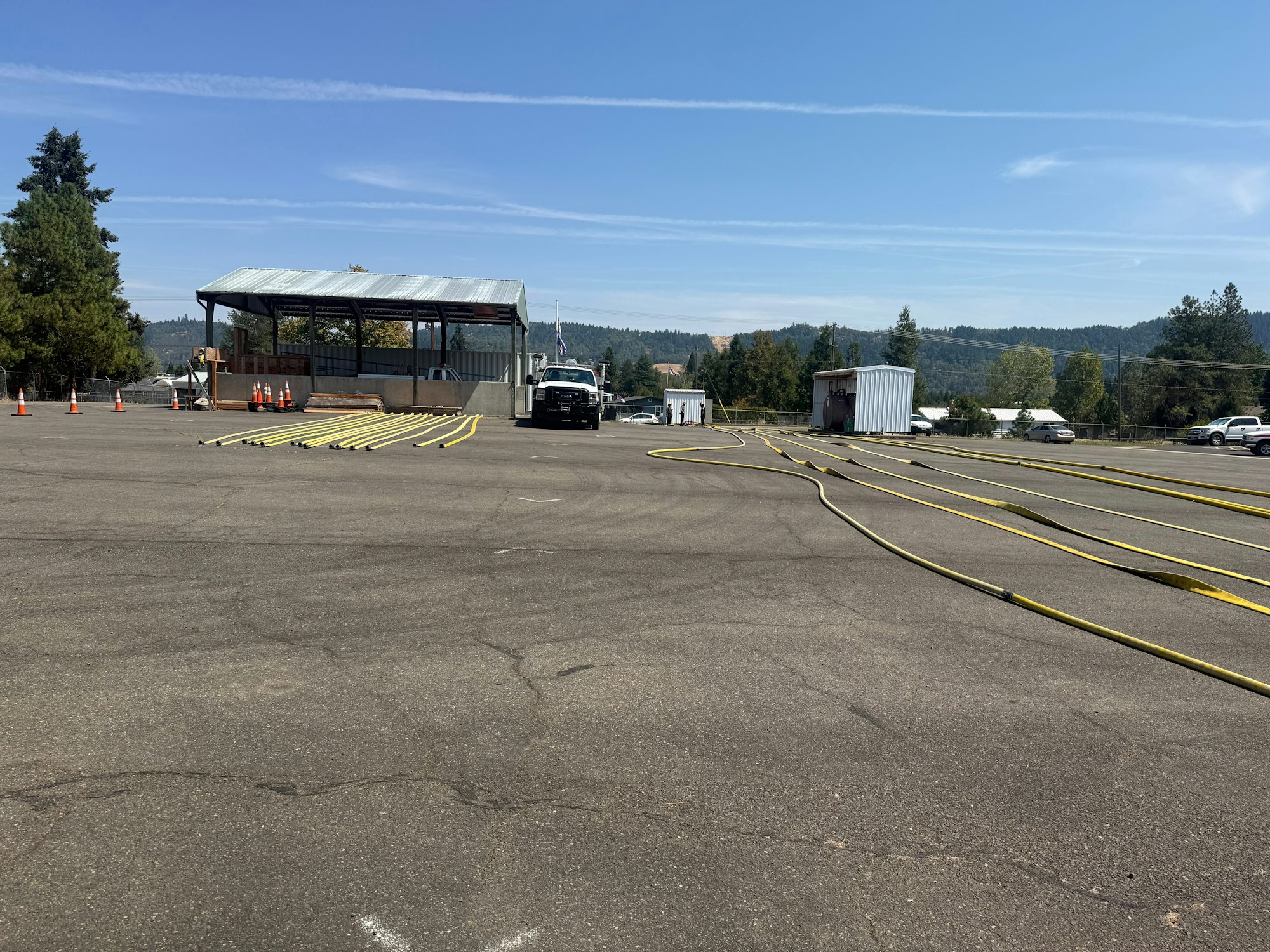
One of the projects LRFD personnel are currently completing is the annual inspection and service testing of the district's fire hose inventory.
For a rural volunteer fire district, projects of this size can be challenging to complete solely during weekly training nights. Having personnel on duty through the OSFM Staffing Grant allows LRFD to complete this work while simultaneously providing additional emergency response coverage within the district.
Nearly 1.5 Miles of Structural Fire Hose
LRFD's structural and tactical apparatus carry a significant amount of attack and supply hose that must be maintained and ready for emergency operations.
Engine 1030
- 1,200 feet of 2½-inch supply hose
- 150-foot 2½-inch preconnected attack line
- Two 200-foot 1¾-inch preconnected attack lines
- 200 feet of spare 1¾-inch hose
- Two 100-foot 1¾-inch hose bundles for extending attack lines
Engine 1031
- 1,200 feet of 2½-inch supply hose
- 150-foot 2½-inch preconnected attack line
- Two 200-foot 1¾-inch preconnected attack lines
- Two 100-foot 1¾-inch hose bundles
Tactical Tender 1060
- 1,200 feet of 2½-inch supply hose
- 150-foot 2½-inch preconnected attack line
- Two 200-foot 1¾-inch preconnected attack lines
- 300 feet of spare 1¾-inch hose
Tender 1061
- 1,200 feet of 2½-inch supply hose
Brush 1080
- 150-foot 1½-inch preconnected attack line
- 300 feet of spare 1½-inch hose
Altogether, these apparatus carry approximately 7,800 feet of structural attack and supply hose—nearly 1.5 miles of hose that must be inspected, maintained, tested, documented, and kept ready for service.
LRFD personnel are currently finishing the structural hose inventory and will begin working through the district's wildland fire hose inventory next.
Why Fire Hose Is Tested
Fire hose is subjected to demanding conditions throughout its service life. It is repeatedly pressurized, dragged across pavement and rough terrain, exposed to heat and weather, loaded and unloaded from apparatus, and subjected to bending and abrasion.
Damage is not always immediately obvious.
Annual inspection and service testing provide an opportunity to identify leaks, damaged hose jackets, coupling problems, movement or slippage of couplings, and other defects before the hose is needed during an emergency.
The fire service's current consolidated NFPA standard covering fire hose inspection, care, and service testing is NFPA 1930. Requirements previously contained in NFPA 1962 were incorporated into the consolidated standard.
During service testing, hose is visually inspected and laid out for testing. The hose is filled with water while air is removed from the system, connections are checked, and pressure is gradually increased to the appropriate service-test pressure. Once the required pressure is reached, it is maintained for the prescribed test period while personnel inspect for leaks, coupling movement, or other indications of failure.
Proper procedures and safety precautions are especially important because a hose or coupling failure under test pressure can release a significant amount of energy.
Turning Required Maintenance Into Training
Completing hose testing in-house provides another important benefit: training our personnel while accomplishing required department work.
Fire hose inspection, testing, maintenance, and associated fireground operations support the knowledge and practical skills firefighters develop as they progress through their Firefighter II training and professional development.
Instead of training being limited to scheduled Thursday night drills, personnel working through the OSFM Staffing Grant can apply their training to actual department equipment.
They gain experience with hose, appliances, pumps, pressure, equipment inspection, documentation, hose loading, and equipment maintenance while completing work that directly improves LRFD's operational readiness.
Keeping Limited District Funding Available for Other Needs
Completing hose testing internally also provides an important financial benefit.
Professional fire hose testing services are available, but contractors may charge based on the number of feet of hose tested in addition to potential travel or other service costs. Published pricing and public contracts have shown commercial hose testing rates in the general range of approximately $0.28 to $0.46 per foot, although actual costs vary by contractor, location, and services provided.
At approximately 7,800 feet, outsourcing LRFD's structural hose testing could represent roughly $2,184 to $3,588 in testing costs. At a rate of $0.41 per foot, the cost would be approximately $3,198 for the structural hose inventory alone.
That does not include LRFD's additional wildland hose inventory.
For a small rural fire district operating with limited funding, several thousand dollars can make a significant difference. Completing this work with trained personnel allows LRFD to direct those funds toward other priorities, including PPE, equipment replacement, apparatus maintenance, training equipment, and other operational needs.
Thank You to Tenmile Rural Fire District
LRFD would also like to thank Tenmile Rural Fire District for loaning the district its dedicated fire hose tester for this project.
A fire hose tester is a specialized hydrostatic test pump designed specifically to develop the pressure necessary for fire hose service testing. Rather than using the large-volume fire pump on an engine, the tester uses a relatively low volume of water to gradually pressurize the hose to its required test pressure.
This allows personnel to conduct controlled testing while monitoring pressure and inspecting the hose.
Using a dedicated hose tester also means LRFD does not have to operate one of its primary response apparatus for extended periods solely to generate the pressures required for hose testing. This helps reduce unnecessary engine hours and wear on apparatus pumps and keeps response equipment more readily available for emergency calls.
Sharing specialized equipment is particularly valuable for neighboring rural fire districts. Not every department needs to purchase every specialized piece of equipment when agencies can work together and share resources.
LRFD sincerely appreciates Tenmile Rural Fire District for allowing us to use its hose tester and for its continued partnership with our district.
More Than Emergency Staffing
The OSFM Staffing Grant provides LRFD with additional emergency response capability during staffed hours, but its value extends well beyond responding to calls.
When crews are not responding to emergencies, those staffed hours can be used to train personnel, inspect equipment, test hose, maintain apparatus, complete station projects, and improve overall operational readiness.
For a small rural fire district, that additional capacity is extremely valuable.
The approximately 7,800 feet of structural hose being tested represents just one example of the work that can be accomplished while personnel remain available to respond to the community.
Every section of hose we inspect and test is one more piece of equipment we know is ready when our firefighters—and our community—need it.